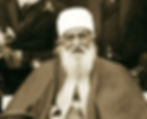
`Abdu'l-Baha: The Master
- Uplifting Words
- Dec 26, 2018
- 3 min read
Updated: Jul 27, 2020

In retrospect, it became clear that from the start Baha'u'llah had carefully prepared `Abdu'l-Baha to succeed Him. He was born on May 23, 1844, the very night of the Bab's declaration. As a child, He suffered along with His Father during the first round of persecutions against the Babis.
`Abdu'l-Baha was eight when Baha'u'llah was thrown into prison. He visited Him there and saw the iron collar and chains around His Father's neck.
"The religion of God is for love and unity; make it not the cause of enmity and dissension." - Baha'u'llah
As He grew older, `Abdu'l-Baha became His Father's closest companion and carried out for Him many important at tasks. He interviewed in advance, for example, the numerous visitors who came to see His Father and protected Him from frivolous or ill-intentioned impositions on His work.
In Acre, when nearly the entire group of Baha'is there became ill with typhoid fever, malaria and dysentery, `Abdu'l-Baha washed, nursed and fed the patients, taking no rest for Himself. Finally, exhausted, He took ill Himself, suffering in critical condition for nearly a month.
These qualities of selflessness, erudition and great humility, along with Baha'u'llah's own obvious admiration, soon won for `Abdu'l-Baha the title of "the Master." It is a term still used today by Baha'is in referring to `Abdu'l-Baha.
Despite the explicit terms of Baha'u'llah's will and testament, some envious relatives attempted to usurp `Abdu'l-Baha's position after Baha'u'llah's passing. Repeated attempts were made by these ambitious individuals to create followings of their own.
It is significant, in view of the swift emergence of schisms in the world's other religions, that none of the resulting dissident groups were able to maintain themselves or create a division of the Baha'i Faith. Ultimately, each group disintegrated with the death of the leader who had tried to establish it and no sects or denominations have endured. Baha'is attribute this unity to the power of the "Covenant."
`Abdu'l-Baha also played a key role in explaining the world-embracing vision of His Father in terms that the Western world could understand, an accomplishment that greatly accelerated the transformation of the Baha'i Faith from a small, Middle Eastern movement into the worldwide religion it is today.
Following the passing of His Father, `Abdu'l-Baha remained a prisoner of the Ottoman Empire. Via letters and through direct contact with early Western believers who traveled to Palestine, He guided the Faith's spread outside the Middle East.
After the revolution of the Young Turks, `Abdu'l-Baha became free to travel. In August 1911, He left the Holy Land on a four-month visit to the Western world, stopping in London and Paris. There He met with early Western believers and gave daily talks on the Baha'i Faith and its principles.

The following spring, `Abdu'l-Baha embarked on a year-long tour, again to Europe, and then to the United States and Canada. The visit greatly stimulated the spread of the Baha'i Faith in those two countries.
During visits to more than 40 cities in North America, He was greeted with respect and acclaim, by both the believers and non-believers alike. In city after city, He was invited to speak at churches and synagogues, and before distinguished groups and organizations.
The net effect was to establish the Baha'i Faith as a major new force for social reform and religious renewal. The message of Baha'u'llah--with its great call for a new and peaceful human society--had been proclaimed in the industrialized world and a new generation of firm believers had been enlisted.
`Abdu'l-Baha established an on-going plan for the internationalization of the Faith. In a series of letters to believers in North America, He asked them to spread out around the world to promulgate the Baha'i Faith and its principles.
By the outbreak of World War I, `Abdu'l-Baha was back in the Holy Land. In His addresses in the West, He had warned about the coming conflagration, and He had spoken unceasingly about the need to establish some form of world commonwealth which might forestall such a war.
During the war, `Abdu'l-Baha spent His time acting on the principles that He and His father had preached. He personally organized, for example, an extensive agricultural project near Tiberias, which provided an important source of wheat to the region and helped to avert a famine in the area. `Abdu'l-Baha was knighted by the British Government after the war.
For a description of `Abdul-Baha by Professor Browne, please click here.